
Easy Ways You Can Identify An Igbo Man

This guide outlines four simple and clear ways to identify an Igbo man, based on tradition, lifestyle, and everyday habits.
The Igbo are one of the most prominent ethnic groups in Africa, with a population of over 40 million spread across Nigeria and beyond.
They have a rich history dating back to around 2500 BC and are well known for their strong sense of identity, cultural heritage, and pride.
Who Are The Igbo People?
The Igbo are one of the largest and most influential ethnic groups in Africa. They primarily reside in southeastern Nigeria, in states such as Abia, Anambra, Ebonyi, Enugu, and Imo.
Smaller Igbo groups also reside in parts of Delta, Rivers, and Benue, as well as in countries such as Cameroon and Equatorial Guinea.
Archaeological finds suggest Igbo communities existed as early as 2500 BC. According to Igbo tradition, their people descended from a figure named Eri, believed to be sent from the heavens to start human life.
Some say Eri was connected to the biblical sons of Jacob.
One of the most important centers in Igbo history was the Nri Kingdom, a theocratic society that helped Igbo customs.
The Igbo language belongs to the Niger-Congo family and is part of the Igboid cluster. It has many dialects, some of which differ widely.
There are about 40 million Igbo people, making up around 18% of Nigeria’s population. Their homeland is among the most crowded areas in Africa.
Many Igbo people also live in the U.S., Jamaica, Cuba, Barbados, and Belize, places where traces of Igbo culture remain.
Traditionally, the Igbo were farmers, growing crops like yam and cassava. They are also known for their education, entrepreneurship, and success in many fields.
Their society was never ruled by a single king. They had many small groups, including the Nri Kingdom and Aro Confederacy.
Christianity is the main religion, but traditional beliefs called Omenala or Odinala still hold meaning.
READ: Who Is The Father Of The Igbo People?
5 Ways You Can Identify An Igbo Man
You can identify an Igbo man by their traditional attire and physical appearance, language and communication, names, cultural values and social behavior, as well as food preferences and lifestyle.
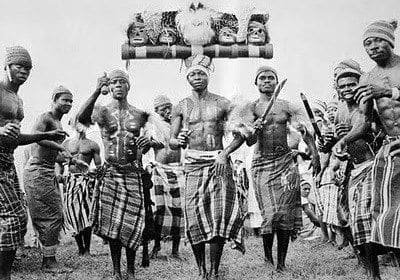
Traditional Attire and Appearance
One of the easiest ways you can identify an Igbo man is by traditional attire and appearance.
Here are some traditional Elements of Igbo Men’s Attire:
1. Isiagu Shirt
The Isiagu, also known as Isi Ago, is a bold, richly embroidered shirt made from velvet or suede.
It has gold or silver lion head patterns, which are symbols of strength and nobility in Igbo culture.
Common colors are red, black, white, and burgundy, and it’s worn with plain trousers during events like weddings and title ceremonies.
2. Wrapper (George Cloth)
A George wrapper is a luxurious cloth tied around the waist, sometimes draped over the shoulder.
It’s made from silk or velvet and adds elegance to the look. You’ll see Igbo men rock it during festivals or formal events.
3. Red Cap (Okpu Ndi Igbo)
The red cap is a key symbol of Igbo male identity. Worn by elders and titled men, it stands for honor, respect, and leadership.
It’s usually velvet and may be replaced with black caps by non-titled men.
READ: Top 10 Igbo Musicians (2025 Ranking)
4. Beads And Accessories
Igbo men wear coral or glass beads in red or white. A walking stick (Mkpọ) also adds dignity, especially for elders.
It’s a symbol of tradition.
5. Footwear
Leather sandals called Akpa-ụkwụ complete the attire. Shawls may be added during formal events.
Language And Speech Style
Another way to identify an Igbo man is by the way he speaks. The Igbo language, spoken by about 40 to 45 million people in southeastern Nigeria.
It belongs to the Niger-Congo language family and dates back to around the 9th century AD.
Igbo has about 30 dialects, but Standard Igbo, based on the Owerri and Umuahia dialects, is widely understood.
Despite these differences, most Igbo people can still understand each other.
Igbo is a tonal language. It uses four tones: high, low, rising, and falling. The word àkwà can mean “cloth,” “cry,” or “bed” depending on tone. This makes Igbo sound musical and rich.
It also has 28 consonants and eight vowels. Sounds like kp and gb are unique and set it apart from other languages.
Traditional writing used Nsibidi symbols, but today the Latin alphabet is common.
You’ll often hear greetings like “Kedu?” (How are you?) or “Dalu” (Thank you). Many Igbo men speak English or Pidgin but mix in Igbo words or speak with an Igbo accent.
Names And Naming Customs
In Igbo culture, a name is a deep reflection of identity, history, and belief. One of the easiest ways to spot an Igbo man is through his name.
Igbo male names carry meaning. Many start with “Chi” or “Chukwu,” which means “God.” For example, Chinedu means “God leads,” while Chibuzo means “God is the way.”
Other names tell stories. Obinna means “Father’s heart,” showing love and family ties. Emeka means “Great deeds.”.
Some names mark when or how a child was born. For instance, Okeke means “born on Eke market day.”
Naming is not casual in Igbo culture. It involves family elders and follows tradition. The ceremony, called Igu Afa, is a public event.
Names can also hint at status or family role. First sons might be called Obi, meaning “home.”
Others like Ogbuagu (lion killer) may come from certain families.
READ: List Of Local Government Areas In Abia State, And Their Chairmen
Food And Lifestyle Habits
One of the easiest ways to spot an Igbo man is through his food choices and eating habits. Igbo cuisine is rich, flavorful.
It is made with native ingredients such as yam, cassava, cocoyam, palm oil, and local vegetables..
Yam is the “king of crops” among the Igbo. It’s eaten boiled, roasted, or pounded into fufu. Most meals are paired with thick soups like Oha soup (made with Oha leaves and cocoyam), Bitterleaf soup (Ofe Onugbu), and Okra soup, a slimy, tasty dish made with fresh okra and meat or fish.
Another favorite is Nsala soup, also called white soup.
It’s light, not oily, and usually cooked with catfish and yam, flavored with utazi leaves. Okpa, a protein-rich steamed snack made from Bambara nuts, is common as breakfast or street food.
Agidi, a corn-based pudding, also shows up at home or events.
They also have Nkwobi, made from spicy cow foot in a palm oil and potash sauce. It’s mostly served at night or during parties.
While Jollof rice is eaten nationwide, the Igbo version often includes meat, rich in iron, zinc, and protein.
Palm oil is a signature ingredient, giving Igbo food its red look and bold taste. Igbo men usually eat with their right hand, scooping fufu into soup.
This isn’t just tradition, it’s part of the Igbo identity. Studies have documented over 294 food species and 400 varieties in the Igbo diet.

