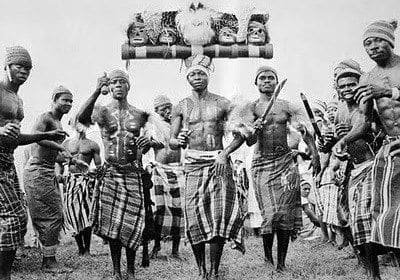

Where Did The Igbos Originally Come From? (The Origins Of An Ancient People)

The Igbo people are one of Nigeria’s largest ethnic groups, with about 40 million people. They live in the southeastern part of the country, in states like Anambra, Enugu, Imo, Abia, and Ebonyi, an area known as Igboland.
Their origins go back to the ancient Nri Kingdom, one of the oldest civilizations in West Africa. In 9th-century Igbo-Ukwu, archaeologists found bronze works that show their great skill in art and trade. Igbo society is known for being decentralized. Rather than kings, they rely on councils of elders, age groups, and village meetings.
READ ALSO: Who Is The Father Of The Igbo People?
How Did The Ancient Nri Kingdom Influence Igbo Identity?
The Kingdom of Nri, which lasted from around the 9th century to 1911, is seen as the cradle of Igbo civilization. It affected the spiritual, cultural, and political life of the Igbo people. Unlike many African kingdoms, Nri did not grow through war.
Its power came from religion, tradition, and respect, not armies. According to Igbo oral tradition, Nri was founded by Eri, a mythical figure sent by God (Chukwu) to bring order to the world.
Though historians debate Eri’s origin, evidence suggests the kingdom began between the 9th and 12th centuries. Its capital, Igbo-Ukwu, is famous for bronze artifacts that show the kingdom’s skill in metalwork and art.
The Eze Nri, or king, was not a warrior but a priest. He ruled through rituals and spiritual laws. His influence stretched over a third of Igboland. Instead of conquering, Nri expanded by sending out mbùríchi, ritual experts, who spread Nri’s customs and won over communities through oaths and ceremonies.
This united scattered Igbo groups under shared beliefs. Nri’s values were rooted in peace, justice, and freedom. It offered refuge to outcasts and freed slaves. Its laws influenced Igbo traditions, including taboos, family roles, and moral rules.
Nri’s religious practices continue to have an impact on Igbo culture. By the 18th century, Nri began to weaken due to external threats like the Benin and Igala kingdoms and the Atlantic slave trade. In 1911, British colonial forces forced the Eze Nri to give up his power. Yet, the Nri kingship lives on as a symbol of Igbo unity and pride.
Where Did The Igbo Originally Come From?
The Igbo are indigenous to southeastern Nigeria. They did not migrate from the Middle East or anywhere else. Archaeological and genetic evidence confirms they have lived in this region for tens of thousands of years, making them one of the oldest human populations in West Africa.
Genetic studies, like those from the African Genome Variation Project, show that the Igbo carry the ancient Y-chromosome haplogroup E-M2, which split about 39,300 years ago.
Their DNA also connects them to early African hunter-gatherers and Khoisan ancestry, originating more than 9,000 years ago. At Ugwuele Uturu, tools from the Middle Stone Age (8000–3000 BC) show long-term human activity.
Even more notable is the Igbo-Ukwu site, from the 9th century AD. It revealed advanced bronze and copper art, proving a wealthy society existed long before other famous West African cultures like Ife and Benin.
Iron tools found in the region, dated between 3000 BCE and 1500 BCE, show the Igbo were early metalworkers, possibly earlier than even the Sumerians. Some myths claim the Igbo came from Israel or the Middle East.
These ideas were mostly created by colonial-era scholars trying to fit African history into Bible stories. But no real evidence supports them. Modern science, history, and archaeology all agree: the Igbo have always been in Igboland.
READ ALSO: Top 10 Igbo Musicians (2025 Ranking)
Where Did The Igbo Language Originally Come From?
The Igbo language, spoken by over 30 million people today, comes from the Benue-Congo branch of the Niger-Congo language family, one of the largest in Africa. It developed in what is now southeastern Nigeria around the 9th century AD.
Unlike one single language, Igbo is a group of many dialects, between 20 and 35, each tied to specific Igbo communities. Due to this variety, Standard Igbo was developed in the 1970s to unify the language, particularly for use in schools, books, and the media.
Yet, most speakers use their local dialects in everyday life. Before the British arrived, Igbo was mostly spoken, not written. During colonial rule, the Latin alphabet was adapted to write the language.
It had to be reshaped to fit Igbo’s unique sounds and tones. The language also grew alongside the rise of the Nri Kingdom around 948 AD. In modern times, colonialism and the Nigerian Civil War also influenced how Igbo is used and valued.
What Is The Largest Political Unit Of An Igbo Tribe?
The largest political unit of an Igbo tribe is the village or village group, not a kingdom or empire. Igbo society is traditionally decentralized, unlike many African groups that had powerful kings or chiefs.
Each village is made up of several kindreds, which are extended family units. These villages are the heart of Igbo political, social, and economic life. They run themselves through village assemblies, where adult males gather to discuss and decide on community matters.
This system is often called Oha-na-Eze, meaning “the people and the king,” though there’s rarely a real king. Instead, power is shared. Elders, titled men (such as Ozo titleholders), and age grades all have a part in decision-making.
Everyone has a voice, especially the wise and experienced. Rather than one person ruling, decisions are made by consensus. However, there are exceptions. Some towns like Onitsha and Arochukwu did have kings or chiefs, but these were not the norm.
Most Igbo communities valued equality and group decision-making over centralized rule. In short, the village, not a throne, was the highest form of authority in traditional Igbo life.
READ ALSO: Top 10 Igbo Gospel Musicians (2025 Ranking)
FAQ
What Are The Theories About The Origin Of The Igbo People?
Theories include descent from Eri (Nri myth), migration from Awka, Idah, or Benin, and links to Niger-Congo peoples. Some claim Middle Eastern roots, but most scholars support an indigenous African origin based on archaeology and genetics.
Are The Igbo People Indigenous To Nigeria?
Yes, the Igbo are indigenous to southeastern Nigeria. Archaeological evidence shows a continuous human presence in Igboland for thousands of years.
Did The Igbo People Come From Israel Or Egypt?
These are seen as myths, while proofs support a native African origin.
What Does Archaeology Say About Igbo Origins?
Archaeological finds like Igbo-Ukwu bronzes show the Igbo lived in southeastern Nigeria as far back as 2000–3000 BCE.
What Is The Significance Of Nri In Igbo History?
Nri was a cultural and spiritual center founded by Eri. It influenced Igbo society through peaceful expansion, rituals, and unique governance, which has made it key to Igbo identity.